Automating machine learning (ML) engineering is a formidable challenge. While industries increasingly rely on ML, creating effective solutions remains complex and labor-intensive. Traditional ML agents, even those powered by large language models (LLMs), often stick to familiar, sometimes outdated approaches and lack the iterative problem-solving skills needed for exceptional results. Google Cloud's MLE-STAR is designed to change this narrative by pushing the boundaries of automation and performance in ML workflows.

How MLE-STAR Innovates
MLE-STAR makes a leap by combining dynamic web search with focused code refinement. Unlike earlier agents dependent on pre-trained knowledge, it actively searches for the latest, task-specific models online, ensuring solutions start with the most current advancements. The agent then iteratively hones its code, concentrating on the most impactful components to maximize performance.
- Web Search Integration: Retrieves state-of-the-art models tailored to each ML task, grounding solutions in timely research.
- Iterative Code Block Refinement: Identifies top-performing pipeline elements through ablation studies, then refines them based on feedback from prior iterations.
- Ensemble Method Innovation: Goes beyond simple ensemble voting, proposing and refining complex ensemble strategies to merge multiple candidates into a single, superior model.
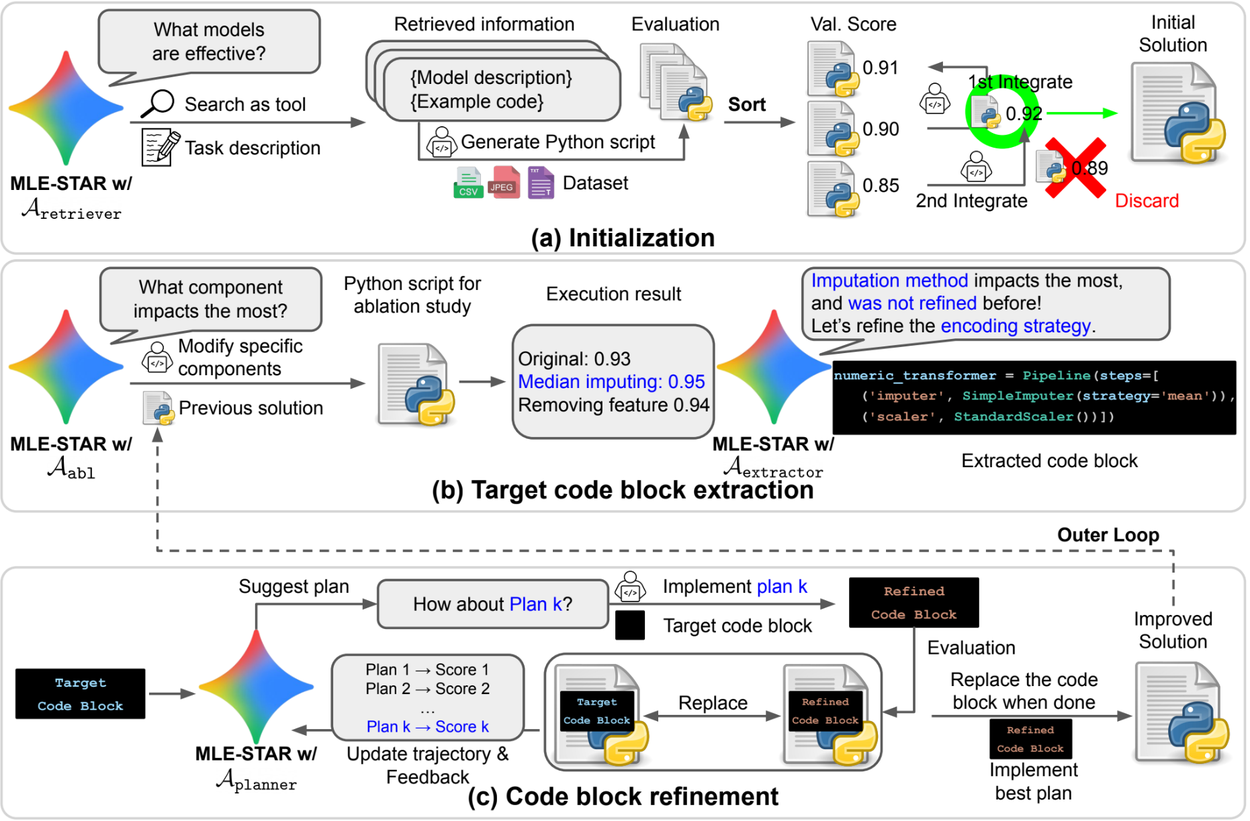
Overview. (a) MLE-STAR begins by using web search to find and incorporate task-specific models into an initial solution. (b) For each refinement step, it conducts an ablation study to pinpoint the code block with the most significant impact on performance. (c) The identified code block then undergoes iterative refinement based on LLM-suggested plans, which explore various strategies using feedback from prior experiments. This process of selecting and refining target code blocks repeats, where the improved solution from (c) becomes the starting point for the next refinement step in (b). Credit: Google
Automation and Built-in Safeguards
MLE-STAR isn't just about model selection and optimization; it embeds key modules to deliver reliable, high-quality results:
- Debugging Agent: Detects and fixes code errors automatically during execution.
- Data Leakage Checker: Flags improper use of test data, a common ML error, to prevent data leakage.
- Data Usage Checker: Ensures all available datasets are utilized for maximum value.
This robust architecture means MLE-STAR can produce submission-ready solutions with minimal human oversight.
Performance on Real-World Benchmarks
MLE-STAR's capabilities were tested on Kaggle competitions as part of the MLE-Bench-Lite suite. The results are impressive as it earned medals in 63% of competitions far surpassing the 25.8% achieved by previous best agents. Of those medals, 36% were gold, highlighting its consistent excellence.
- Adapts quickly to cutting-edge models like EfficientNet and ViT, while others rely on legacy standards.
- Allows human experts to intervene seamlessly, integrating novel models that may not yet be widely available online.
- Integrated error correction and data validation modules address common LLM-generated issues, such as data leakage and missed datasets.
Behind MLE-STAR's Performance Edge
Several factors drive MLE-STAR's superior outcomes:
- Model Freshness: Web search ensures selection of the latest high-performing models, not just defaults.
- Human-LLM Synergy: Minimal expert input—like describing new models—can be quickly incorporated, enabling fast innovation adoption.
- Automated Safeguards: Built-in checkers correct hallucinations and omissions, refining outputs beyond standard LLM capabilities.
Broader Implications and Looking Ahead
MLE-STAR proves that smart automation can lower barriers in advanced ML engineering. By grounding solutions in current research and codifying best practices, it empowers both newcomers and seasoned practitioners to achieve robust results with less manual effort. Its web-driven approach means solutions stay up to date as ML evolves, promising continuous improvement with little user intervention.
The codebase is open source, inviting the community to experiment and contribute. While currently research-focused, MLE-STAR marks a leap forward for automated ML engineering and could drive future innovation across sectors.
Key Takeaway
MLE-STAR is setting new standards for ML engineering agents by merging web search, targeted code optimization, and robust automation. Its superior benchmark performance and open-source nature signal a future where advanced, adaptable ML solutions are more accessible than ever.


MLE-STAR: Redefining Automated Machine Learning Engineering with Web Search and Iterative Refinement